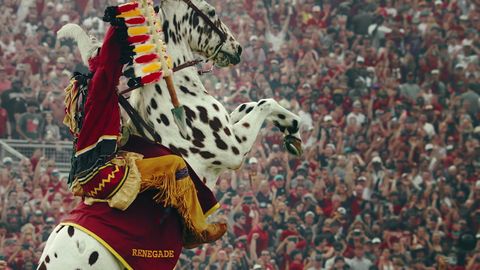
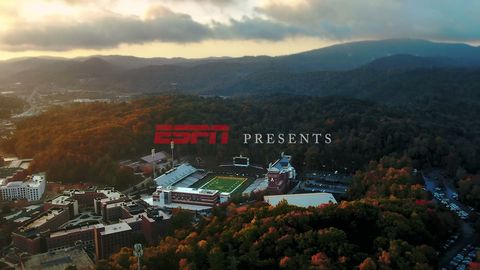
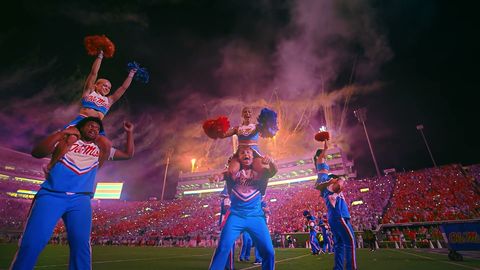
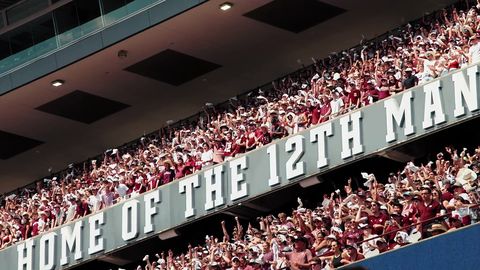
A nature documentary about college football, narrated with the reverence usually saved for wildlife. The tailgate, the rivalry and the student section, observed in the wild.
ClientESPN
CategorySports, Broadcast
DisciplinesEditorial · Color · Sound
StudioWorkprint
Credits
ESPN
Creative DirectorMike Dominguez
Sr. ProducerJonathan Weber
ProducerCameron Gross
Associate ProducerSean Andersen
Production AssistantUnique Parker
Workprint
Creative Director / EditorDavid Nitzsche
EditorEliza Smallwood
ColoristMyles Mantzaris
FXTim Devlin
WeFoundSound
Producer / Creative DirectorEric Hillebrecht
ComposerJason Payne
Inside the work
COLLEGE FOOTBALL. OBSERVED IN ITS NATURAL HABITAT.
Wild World of College Football
Most sports advertising has one setting: louder.
Bigger hits. Faster cuts. More crowd. More stakes. By the time Saturday arrives, everyone is selling college football like civilization itself may depend on the outcome of the 3:30 game.
Wild World of College Football looks at the same world through a very different lens. ESPN's campaign observes the sport with the seriousness usually reserved for wildlife documentaries. Tailgates become ritual. Rivalries become territorial disputes. Student sections become their own strange species.
ESPN brought the nature-documentary idea. We went digging for the wild.
Workprint handled editorial, color and audio, collaborating with We Found Sound on the original score, sound design and audio post. The opportunity was to make the world believable enough for the joke to work, while keeping everything people love about Saturday football.
Workprint: Editorial, color and audio. Creative Director / Editor: David Nitzsche. Editor: Eliza Smallwood. Color: Myles Mantzaris. Original music, sound design and audio post: We Found Sound. We Found Sound Producer / Creative Director: Eric Hillebrecht. Composer: Jason Payne.
01 / Wild World of College Football
FIND THE WILD. BUILD THE STORY.
ESPN supplied terabytes of footage, without a storyboard or a shortlist of shots. There was a clear premise, but the film still had to be found inside the material.
That distinction matters. A spectacular football shot isn't automatically a useful nature-documentary shot. The footage needed to give us behavior, environments and little observations that could take on a different meaning beside the narration.
The opening developed in conversation with ESPN: start wider, make the world feel compelling, then move closer to the creatures living inside it. That progression gave the film a point of view before it asked the audience to laugh.
The voiceover helped establish the rules. We tested different reads against the footage, then pared the narration back to reach thirty seconds without losing the premise or its flow. Every line left in the cut had to earn the time it occupied.
02 / Wild World of College Football
THE FUNNIER WE TREATED IT, THE LESS FUNNY IT GOT.
This kind of comedy is fragile. Push a reaction too hard and the piece starts performing the joke for you. Cut every amusing image straight to another and it becomes a collection of gags. Treat the footage like a conventional hype reel and the documentary conceit disappears.
The useful tension was sports energy underneath, documentary restraint on top.
A fan doesn't need to be announced as a punchline. The voice, framing and duration of the shot can make familiar behavior feel newly ridiculous. Give the audience enough room to notice it and the contrast does the work.
That made timing part of the performance. A look held a little longer, a line given space, a cut arriving just after the thought lands: small decisions keep the film committed to its own strange reality.
03 / Wild World of College Football
PACE BECOMES PERFORMANCE.
There was another practical problem inside that tonal one. Some teams simply had stronger footage for a particular editorial moment. Letting those selects dictate the entire film would have made the campaign's world feel narrower than it needed to.
Our approach was to make the moment work first, then look for alternative teams or players that could do the same editorial job. Representation could change without casually throwing away the rhythm or the joke.
That's the difference between filling slots and building a film. The shot belongs because of what it does in the sequence. Replacing it means finding another image that can carry that responsibility.
04 / Wild World of College Football
THE CUT SET THE RHYTHM. THE SCORE RAN WITH IT.
The sound had to believe the premise, too. An ominous trailer track or a generic wall of sports music would pull the film toward a different genre.
Working with ESPN, the music direction moved toward a more piano-led approach. Our temporary beats and dropouts established a rhythm in the edit. We Found Sound then scored to that structure, developing the musical character around the film rather than asking the footage to obey a finished track.
That collaboration is important to the result. The score could give a moment scale, leave a pause alone or carry us toward the next burst of football without explaining every joke. Color and the audio finish helped the many environments feel part of the same observed world.
One idea surviving every department.
05 / Wild World of College Football
WHAT THE JOB ACTUALLY PROVES
We understand tone. More usefully, we know how to turn a tonal brief into decisions you can see and hear.
Dry. Cinematic. Restrained. Funny but not too funny. Those words only become a film when somebody finds the footage, the duration, the sound and the relationship between them.
06 / Wild World of College Football
WHAT THIS MEANS FOR YOU.
If the idea lives or dies on tone, bring us in while the film is still being found. We'll build the cut around what makes the idea work and carry that intention through the finish with the right collaborators.
Because sometimes the difference between a great concept and a bad commercial is about twelve frames.